

 De
De  Es
Es  Fr
Fr  Pt
Pt 

-
-
-
-
-
-
-
-
-
-
-
-
-
-
-
-
-
-
-
-
-
-
-
-
-
-
-
-
-
-
-
-
-
-
-
-
-
Tools to Work with Surfaces
-
-
-
-
-
-
-
-
-
-
-
-
-
-
-
-
-
Tools to Work with Surfaces
The surfaces are automatically created according to the Delaunay triangulation rules. Therefore, after creating a TIN, it is often required to edit some areas. Also, in the process of working with relief, sometimes the task of clarifying the surface arises. To do this, the surface editing functionality is used.
To work with surface editing commands, it is recommended to enable shaded visual styles: 3D Flat-shaded with edges, 3D Gouraud-shaded with edges.
When creating a surface, you can use a custom name and a numerical index. When copying a surface, the maximum index will be appended to the new object’s name (if the last name is “Mesh 4”, then new meshes are numbered starting with “Mesh 5”). When moving a copied object to a new drawing, the object’s name is copied.
 Ribbon: Topoplan – Modify TIN >
  Flip Edge
Menu: Ground – Editing TIN >  Flip edge
Toolbar: Editing TIN > Flip edge
 Command line: NG_MESH_FLIP
The command changes the edge position between two triangulation faces in the surface model (SubMesh or Polyface mesh); it can be performed, for example, to turn edges along the slope crest, road side, etc.
When you run the command, an object snap is enabled, and then you should specify an edge for a flip.
When you hover the cursor over the mesh, two adjacent triangles the position of face between which will be changed are highlighted in red. A click on the face flips the edge.
|
Surface before flip |
Surface after flip |
|
|
|
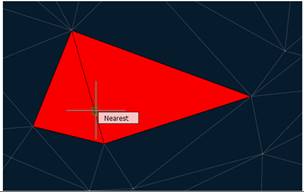
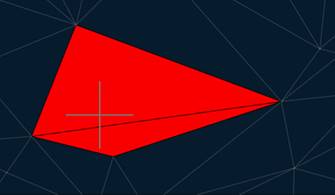
The position of several faces can be subsequently changed. Pressing ESC ends the command.